
1974 was the last year before a very big and important change in the image of the coin of the 200th anniversary of the country (1776-1976), which, however, doesn’t mean that the 1974 quarter value is high.
For most of the ordinary quarter dollar coins that were made that year and used by people as money, their price for collectors remains very low, barely exceeding the face value.
Where the Coin Sits in the Series
The 1974 quarter dollar coin, issued since 1965, first issued in 1932 to commemorate the 200th anniversary of the first President George Washington.
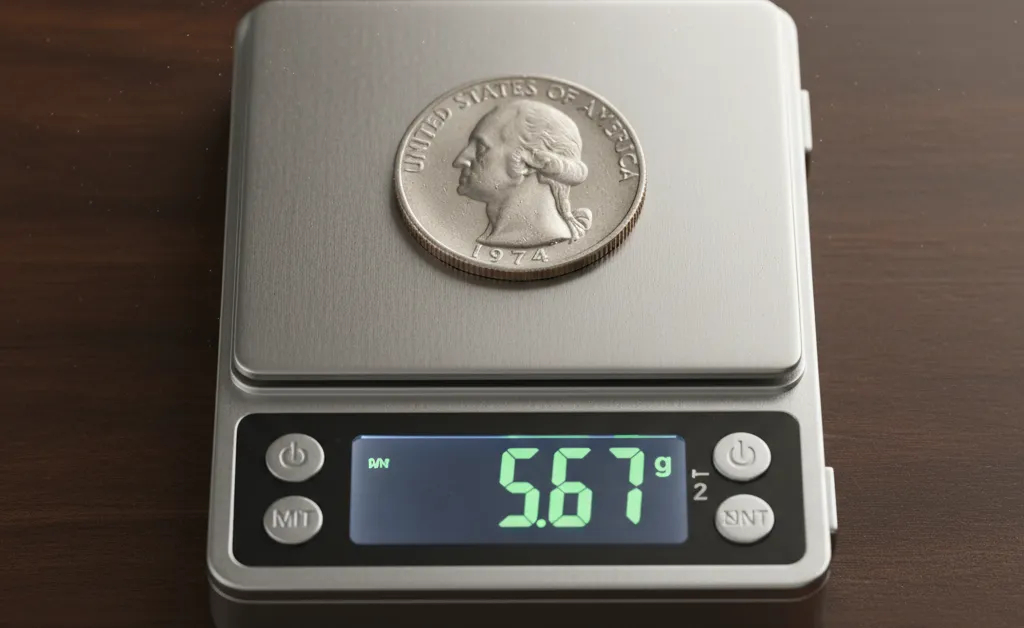
Their size is approximately 24.26 mm and their weight is 5.67 g, since coins issued before 1965 contained silver inside and had a different weight.
The Metal and What the Coin is Made Of
There is no silver in the 1974 coin, as these types of coins, which have been produced since 1965, are made from a metal mixture of a material that has different parts made of different metals:
- Pure copper makes up the center of the coin, and this gives it weight.
- The two outer parts, or layers, are made of a mixture of 75% copper and 25% nickel, giving the coin a silvery color and making it durable for a long time.
Even if the prices of nickel and copper had increased significantly, it would still be worth very close to its 25 cents.
Where the Coins Were Made
In 1974, there were several places in the United States where coins were minted, and each of these places used its own special letter, or mint mark, which you can find on the obverse of the coin, usually under the image of President Washington, and this small letter is the second most important after the condition of the coin when determining its price:
- No Mark (P): Philadelphia-made coins were traditionally unlabeled until 1980, and most 1974 quarters were made here, so they are easiest to find.
- The Mark “D”: This letter means that the coin was made in Denver, which was the second largest producer that year, and Denver coins usually have the same price as Philadelphia coins.
- The Mark “S”: This letter stands for San Francisco and was only used to make special high-quality coins designed for collectors, which people call Proof coins, and these special coins have a much higher base price than the regular coins used by people every day.
Looking at the Price of Coins P and D Marks
A very large number of quarters issued in 1974, more than 600 million pieces from both Philadelphia and Denver, guarantees a low base price for them, so the price of these coins, which were used as money, is determined only by their condition, which professional coin dealers evaluate at auction.
The numerical scale is from 1 to 70.
Most people who collect coins only need those that are stored in a condition close to the new one, which is called Mint condition (MS), when there are no signs of human use or rubbing on the coin, and here is a list showing the possible market prices in US dollars for these coins. 1974 issue quarters made in Philadelphia (without marking and Denver with D.
| Condition | Price (P / No Mark) | Price (D) |
| G-4 | $0.30 – $0.50 | $0.30 – $0.50 |
| VF-20 | $0.40 – $0.75 | $0.40 – $0.75 |
| AU-50 | $1.00 – $2.00 | $1.00 – $2.00 |
| MS-63 | $4.00 – $8.00 | $4.00 – $8.00 |
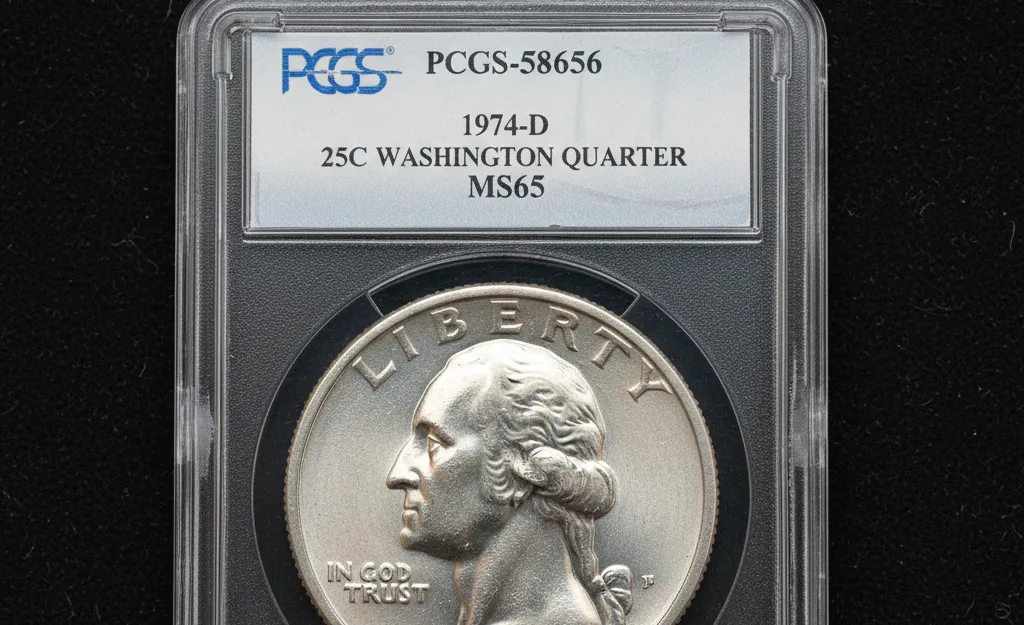
| MS-65 | $8.00 – $15.00 | $8.00 – $15.00 |
| MS-67 | $50.00 – $100.00 | $50.00 – $100.00 |
The Rarity of Grades MS-68 and Higher
A 1974 MS-68 coin can be sold at auctions for prices exceeding 1,500-2,000 dollars, and coins of even higher quality (MS–69 or MS-70) are practically unknown or would cost many thousands of dollars, but their chances of being found are low.
The real one is more of a theory than the real thing that often happens in the market.
The Price and Importance of Proof Coins
The 1974 coins, made in San Francisco with the “S” mark, were made only for collectors and were never intended to be used as money, which immediately makes their price higher than the cost of ordinary quarters that people use every day.
These coins are characterized by a particularly high quality of workmanship: they have a mirror background and a matte relief pattern, and immediately after manufacture they were placed in special safes.
Price Range for 1974 Proof Coins
Trial coins are priced on a different numerical scale, usually from PR-60 to PR-70, and their price is much more stable than that of coins used on the market.:
- PR-65: A coin with a great luster and very small markings that are barely visible on the surface, costs about 2.50 – 4.00 dollars, and it’s still a low price because millions of them were made.
- PR-70 (Perfect Proof): The perfect, flawless coin that every collector dreams of; the price of this coin in a special box can reach $25-50, but this is the highest price for coins of the 1974 sample, which do not have any special errors.
The DCAM Factor
Some trial coins have a special look called a deep cameo (DCAM), when there is a very strong difference between a mirrored, almost dark background and a bright, dim image of Washington.
Coins with a bright DCAM are in high demand, and they can be sold for a small additional price, usually $5.00 – $15.00 for a high–quality coin (PR-67 DCAM and above).
Mistakes and Rare Differences
Doubled Die DDO/DDR
Simple Description: This is the most common mistake when the image on a coin looks a little forked or blurred due to the fact that the image was incorrectly applied to the stamp.
Price: If a really large and clear 1974 dual matrix (DDO) is found, its price in high-quality performance (MS-65) can easily reach 500-1500 dollars or more, depending on how badly the image is divided and how easy it is to see, but right now, it’s official about major DDoS-Nothing is known about the attacks in 1974.
Broadstrike
Simple Description: This happens when a coin is made without a ring holding it in place, which causes the metal to spread over the normal edge of the coin.
Price: This mistake is easy to spot and is highly appreciated; a 1974 quarter with a good wide coinage can cost anywhere from $50 to $200, depending on the coin’s width and purity.
Off-Center Strike
Simple Description: The stamp does not fall on the coin in the middle of the metal product, so part of the image may be missing, and you may see a flat empty area on the coin.
Price: The more the image is off-center, the higher the price; a 1974 quarter, off-center by 50%, can cost anywhere from $100 to $500.
Struck on Wrong Planchet
Simple Description: This is the rarest and most expensive mistake when a small piece of metal replacing another coin (for example, a dime, which is equal to 10 cents) mistakenly ends up in a machine that produces a quarter.
Price: A 1974 dime coin cast in metal will be smaller in size and will probably sell for $1,000 to $5,000, depending on the condition of the coin and how clear the picture on the coin remains.
Rare Things in Philadelphia Coins (P)
Despite the fact that so many coins were issued, 1974 coins made without markings may have small but valuable details, such as clear stamp polishing lines or special metal inserts that make the coin special in its own way.
These little things by themselves do not make a coin very expensive, but they can increase its price by several tens or even hundreds of dollars in the case of high-quality coins (MS-66 and above) for people who specialize in collecting.
Final Advice on Price
To put an end to this, it is necessary to say once again that the 1974 quarter, unlike the famous coin that appeared after it (1776-1976), is an ordinary, everyday coin produced in large quantities, doesn’t contain expensive metals and, in 99% of cases, the price of which is very close to its 25 cents.
For this coin to be of great value to collectors, it must be in Gem Mint (MS-67 or MS-68) condition, which means it looks like it just got out of a car, without minor scratches or scuffs on the parts, which happens very, very rarely.
There must be an obvious and major manufacturing error in it, for example, the blow was struck far from the center or on the wrong metal, or there must be a special test coin with the “S” sign, although the maximum price for such coins is also limited.
For any coin from 1974 that looks very clean but has even the slightest traces of use, its price probably won’t exceed one dollar, but if you really think you’ve found an MS-67 coin or one with an obvious mistake, the best advice is to take it to PCGS or NGC, because only their the official number can verify that the coin is real, assign it a rating, and set its final high price at auctions.